
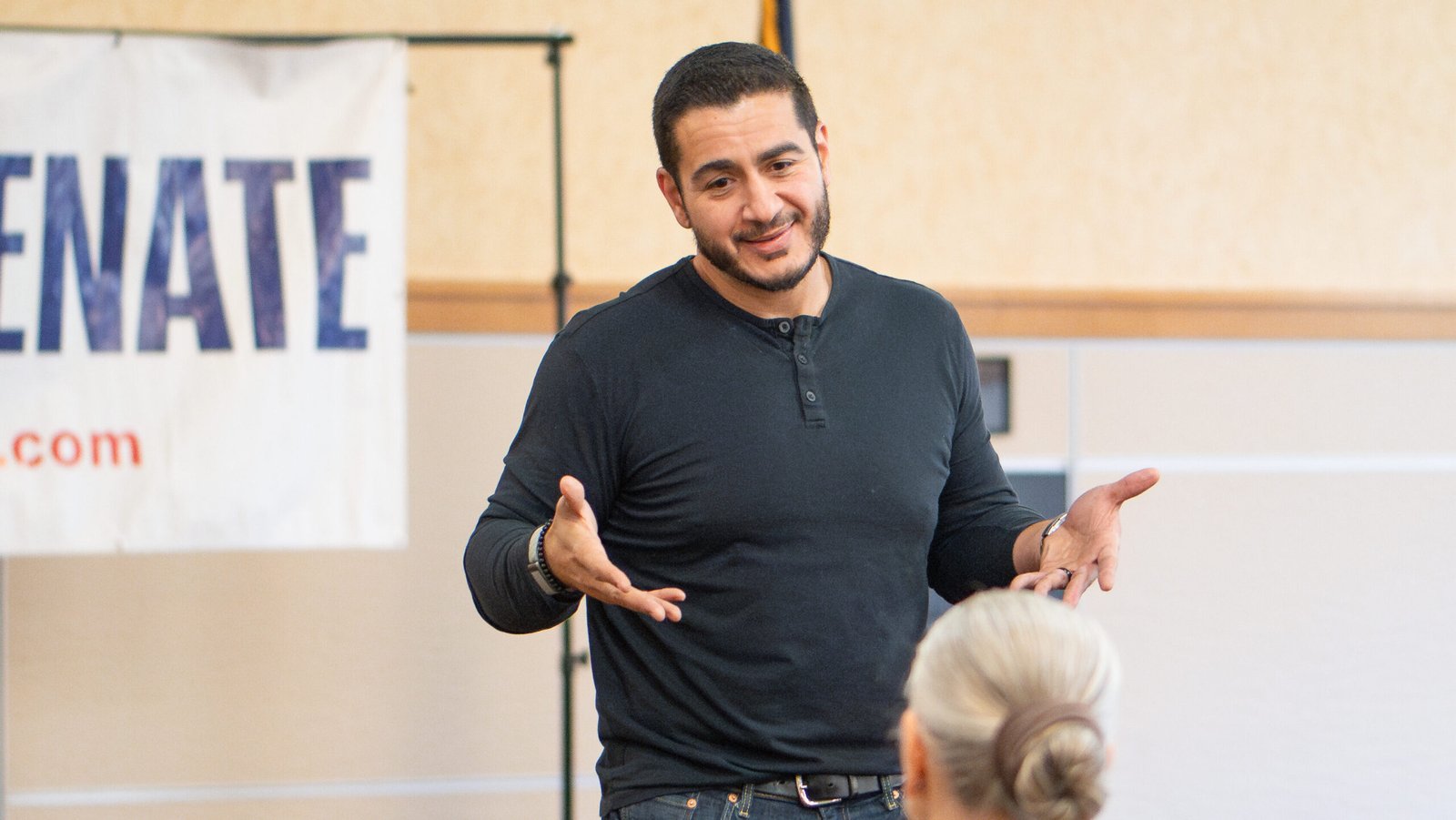
Michigan Democratic Senate nominee Abdul El-Sayed is retailing an old, tired lie.
If Socialist Senator Bernie Sanders were to get up on stage and tell a crowd of supporters that Republicans only oppose him because of his name, no one would take his claim seriously. An obvious and wide gap exists between Sanders’ policy preferences and those of the GOP.
But El-Sayed and his defenders have insisted opposition to the Far-Left candidate is—at least in part—motivated by their fear of his name. This is a game Democratic politicians from former president Barack Obama to Representatives Ilhan Omar (D-MN) and Rashida Tlaib (D-MI) have played for a long time, and it is getting very old.
Other political figures with similar identities and backgrounds–but a different political ideology—have been embraced by Conservatives while being scorned by the Left. The Somali-born author and human rights activist Ayaan Hirsi Ali has been widely protested and even had events cancelled after Far-Left pressure.
By the Left’s same logic, Republicans could claim that Democrats oppose Hirsi Ali because of her name. But of course, that’s not the case. Hirsi Ali possesses a very different worldview than her political opponents—just as El-Sayed, Omar, and Tlaib possess a different worldview than Conservatives. In fact, they have ventured so far to the Left, they’ve begun to leave even Progressive members of their own coalition behind.
This heavy reliance on identity politics rather than policy prescriptions is a problem that has arisen on both the Left and the Right to some degree—but it has become a predictable pattern for Democrats over the past two decades.
When a woman on the Far Left is criticized by the Right, they claim it is simply because they are a woman and America’s enduring sexism is to blame. Or as both Representatives Omar and Alexandria Ocasio Cortez (D-NY) have insisted, they are singled out—not for their extreme political ideology—but because they are just too darn attractive.
Never mind that for all their talk of fighting the patriarchy, Progressives do not reserve for any man a fraction of the vitriol they pour out on Conservative women—who are persistently mocked and maligned as wildly emotional, too stupid for politics, and undeserving of positions of power which Progressives insist these women only achieved because of their looks. All the worst sexist tropes are perfectly acceptable so long as the women in question are Conservative.
The same thing can be said for other identity groups. There is perhaps no group more disparaged by certain Progressives than Black Conservatives. And every vile trope which was once raised by White Supremacists of an earlier age rears its ugly head again when a Black Republican seeks office. Herschel Walker was painted as unsophisticated and undereducated. Clarence Thomas was depicted as angry, promiscuous, and a danger to women. Thomas’ fraught Supreme Court confirmation hearing was so ugly, the Justice deemed it a “high-tech lynching.” Even Herman Cain was slandered as a man who harassed women.
When a Black female Democrat loses an election, Progressives declare voters aren’t ready to vote for a Black woman. But when Virginia Lieutenant Governor Winsome Sears—a Black female Republican—fell short in her bid to become Governor last fall, no similar lamentation was heard. Had Sears been a Democrat, the cry from Progressives would have been “It’s about time Virginia has a Black woman governor.” But seeing she was a Republican, I suppose their thought must have been “We can wait a little longer.”
Similarly, Larry Elder was the target of an attempted assault when a white woman in a gorilla mask threw eggs at him as he campaigned to become the first Black governor of California in 2021. But this disgusting incident was largely ignored and buried because Elder was a Republican. Instead of focusing on the racist assault, Progressives labeled Elder “The Black face of White Supremacy.” But Elder was a moderate Republican and certainly no White Supremacist.
And as Representative John James (MI-R)—the son of a truck driver and great-grandson of a sharecropper—seeks to become the first Black governor of Michigan and only the fifth Black governor in US History, Progressives seem to have concluded that his identity doesn’t matter nearly as much as it would if he were one of them.
This is not to argue that we should vote for candidates based on their identity groups. Of course we should not. We should vote based on principles and policies—but this is the case Conservatives have been making for years while Democrats insist voters support candidates based on their race, religion, or gender—so long as those candidates are Democrats. If these non-white or female candidates are Republicans, certain Progressives have opposed them even more vehemently than they opposed the “Old White Men” they supposedly wish would disappear.
When former President George W. Bush nominated the highly-qualified Miguel Estrada to serve on the U.S. Court of Appeals D.C. Circuit, Democrats blocked his nomination with an unprecedented drawn-out filibuster, which leaked communications from Democratic operatives revealed was partially inspired by the fact that “he is Latino, and the White House seems to be grooming him for a Supreme Court appointment.” Despite his qualifications and Republicans’ repeated attempts to break the Democrats’ filibuster, Estrada ultimately withdrew his nomination. Democrats did not oppose Estrada because they were racist against Hispanic Americans. But their infatuation with identity politics drove them to go to extraordinary lengths to prevent Republicans from nominating the first Hispanic Supreme Court Justice in U.S. history.
And this strange form of prejudice lives on today. After El-Sayed ally and Communist sympathizer Hassan Piker came under fire for vulgar sexist and xenophobic attacks against a Vietnamese refugee from Communism, Piker defended his remarks, claiming such language is acceptable if directed at a non-white individual who happens to be a Conservative.
So no, this campaign is not about El-Sayed’s name–and opposition to his candidacy is about his ideology, not his identity. It is entirely fair for voters to be concerned about El-Sayed’s position on the Muslim Brotherhood—not because of his identity, but because of his history. His half-sister claimed their family had “long been” associated with the Muslim Brotherhood. And after the 2012 Arab Spring, El-Sayed himself signed an open letter to the new Muslim Brotherhood government of Egypt under Mohamed Morsi titled “Statement by Morsi Supporters in America Backs His Decisions and Calls on Him to ‘Purge the Media and Police.’” A totalitarian crackdown on criticism of Islam and Morsi’s government ensued.
It is not racist nor Islamophobic to ask questions about El-Sayed’s own beliefs and past actions. Nor is it Islamophobic to oppose the Muslim Brotherhood—an organization outlawed by several Muslim countries including Egypt, Saudi Arabia, the United Arab Emirates, Bahrain, and Libya. In fact, the Muslim Brotherhood is banned in more Muslim-majority nations than Western nations.
While El-Sayed insists his critics only care about how he prays, many across the globe who pray the same way have raised the exact same concerns as Michigan voters.
Even Democrat Haley Stevens has endorsed El-Sayed’s Republican opponent Mike Rogers—the man she was supposed to run against before El-Sayed narrowly defeated her in the primary.
Perhaps El-Sayed’s problem isn’t everyone else’s supposed bigotry—maybe it’s just that he has bad ideas. Usually, it’s as simple as that.





Leave a Reply